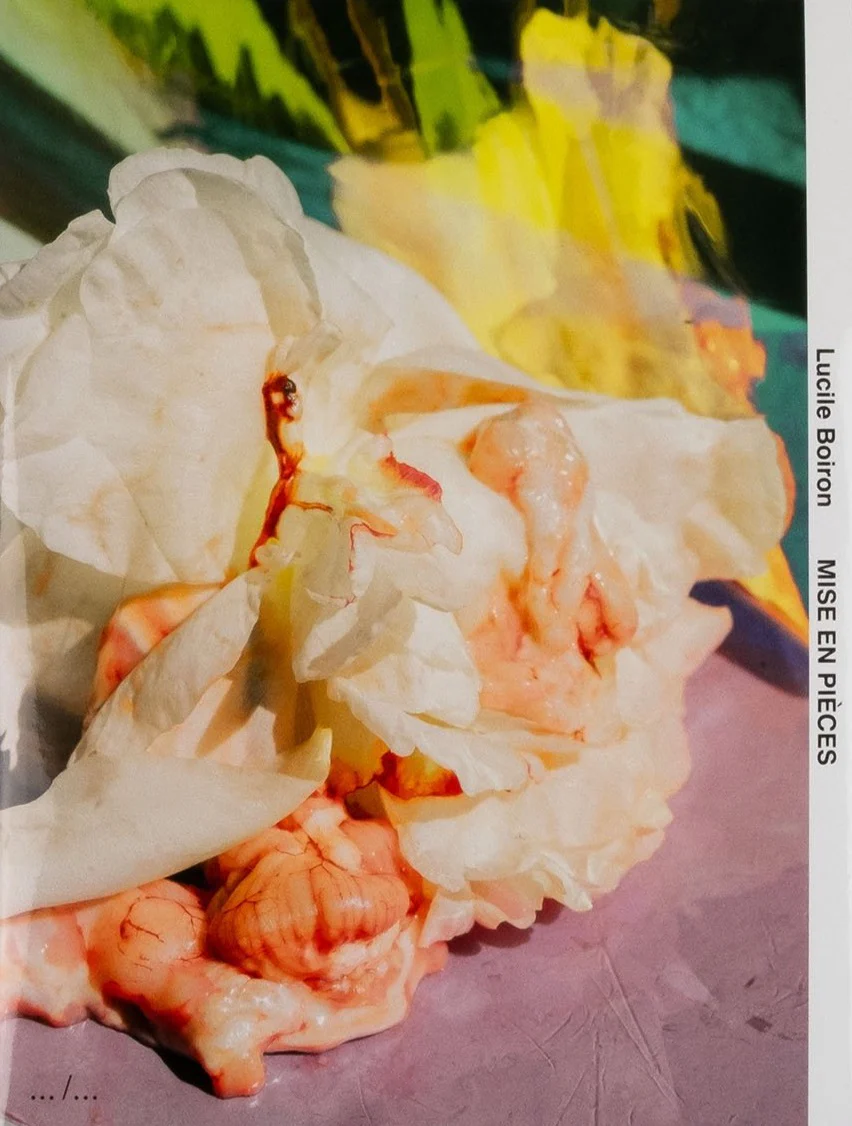
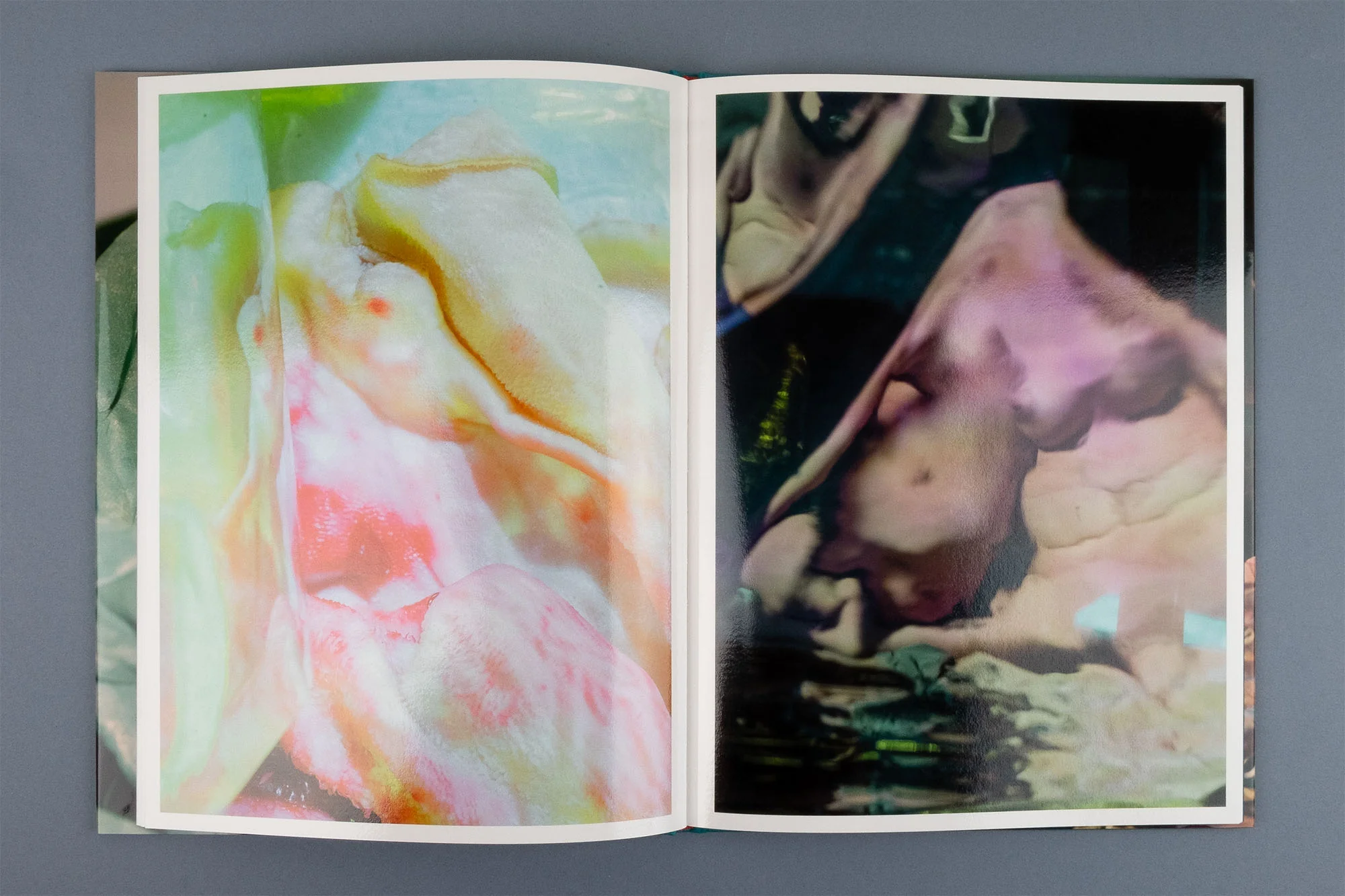
Charlotte Lapalus - Nuages
Book Launch / Signing
January 23, 2024
6 - 8 PM
***
"1802, Lombard Street, London: a certain Luke Howard (1772–1864), an English pharmacist who became a renowned meteorologist, proposed a new classification of clouds. Naming three main categories—cumulus, stratus, and cirrus—as well as a series of intermediate states and modifications, such as cirrostratus or stratocumulus, Howard emphasized the intrinsic mutability of clouds, a crucial point—and fundamentally poetic task—that had been missing in the first classification attempt made earlier by the French naturalist Jean-Baptiste Lamarck (1744–1829).
From then on, history would recognize Howard as the “inventor of clouds,” science would adopt his system, and artists would draw inspiration from it. Seas of mist in Caspar David Friedrich, stormy skies in William Turner, or puffy masses in Eugène Boudin: for the British critic John Ruskin, the 19th century was “in the service of clouds”[1]. Among these painters attentive to atmospheric variations, John Constable (1776–1837), settled atop Hampstead Hill in north London, devoted himself particularly to the meticulous study of clouds. For Constable, the shapes and colors of these water vapor masses—and through them, the scientific phenomena that gave rise to them, as well as the weather that would follow—became genuine objects of study.
At the end of the 19th century, in 1873, three meteorologists from the International Meteorological Organization—Hugo Hildebrand Hildebrandsson, Albert Riggenbach, and Léon Teisserenc de Bort—were tasked with creating the first International Cloud Atlas. They worked on it for twenty-three years, and the first edition was finally published in 1896. In addition to paintings and drawings, it featured, for the first time, color photographs of clouds, a complicated and costly process at the time. The work, still relevant scientifically today, can also be regarded as an art book, reflecting the alliance between science and photography, as well as the infinite aesthetic potential of clouds.
It is in this light of pictorial and meteorological studies that we can understand Charlotte Lapalus’ book “Nuages”, which, from Europe, Canada, or the Sahara, continuously records remarkable states of the sky.
Her framing, devoid of any terrestrial reference, recalls Constable’s Cloud Studies: the sea above which clouds form, the mountains in which they cling, or the plains darkened by their passage all disappear from her photographs. Attention is entirely focused on the motif and the light: here, the opaline filaments of a cirrus, there the dark, muted curls of a cumulonimbus, or the restless masses of nimbostratus slowly coalescing before suddenly glowing from within. In a chromatic stroll—reflecting their evolving nature—clouds shift from white to gray, turning pink, yellow, or purple, depending on altitude, the blue of the sky, or the sun’s position relative to the horizon. At times, special illuminations, such as fires or city lights, interfere with their natural colors.
New questions arise in the Anthropocene. Contrails from jet planes, urban smogs, factory plumes, and mushroom clouds have entered the atmospheric landscape since the beginning of the Industrial Revolution. These are called anthropogenic clouds, all sharing the common feature of being artificially created by human activity.
Moreover, in the 1950s, the first tests of cloud seeding—and with them climate manipulation—began raising new health, ecological, and geopolitical concerns, including the potential establishment of a legal status for clouds, which seemed to know no borders, yet became entangled in weather-related conflicts. While the effects of their behavior and future transformations play a decisive role in climate disruption, they remain one of the main sources of uncertainty faced by researchers and modelers.
In this nebulous context, Charlotte Lapalus’ photographs appear as a call to cultivate our powers of observation, to enhance our attention and interest in these cottony giants. Their masses, sometimes imposing, their muted or incandescent tones, shout mystery, urgency, and poetry, a triad with which one must contend when speaking of these scientific UFOs that endlessly form at the surface of the water and rise into the troposphere."
[1] John Ruskin, Modern Painters (1840)
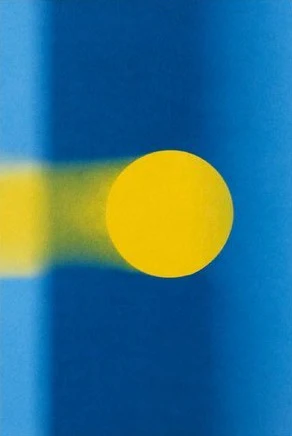
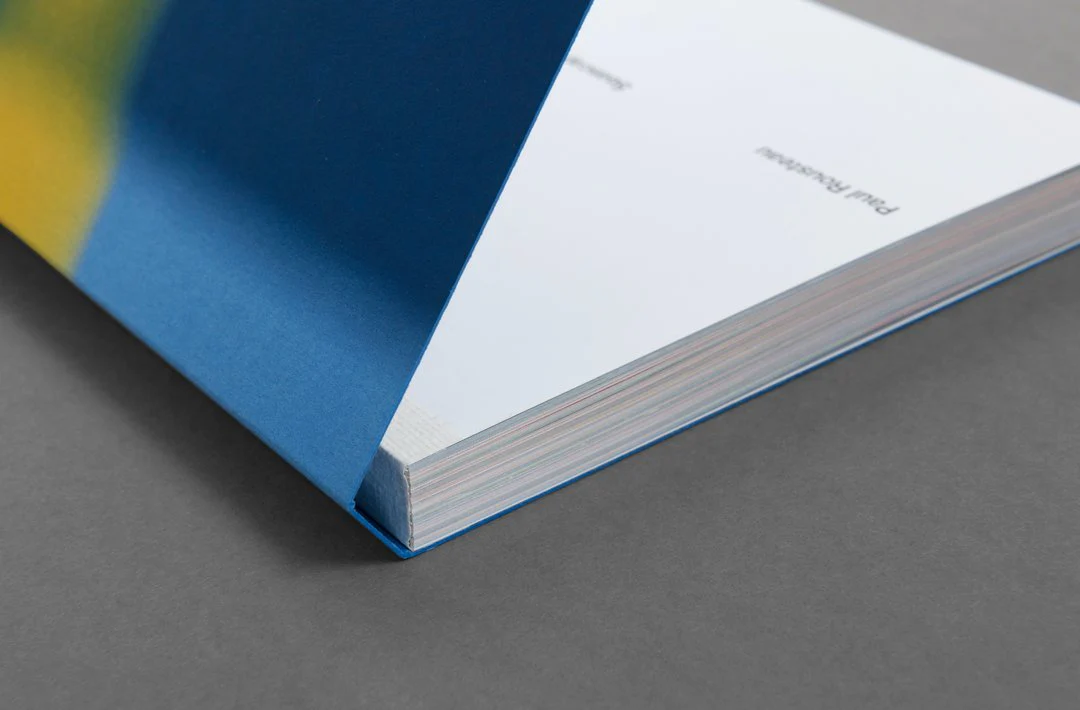
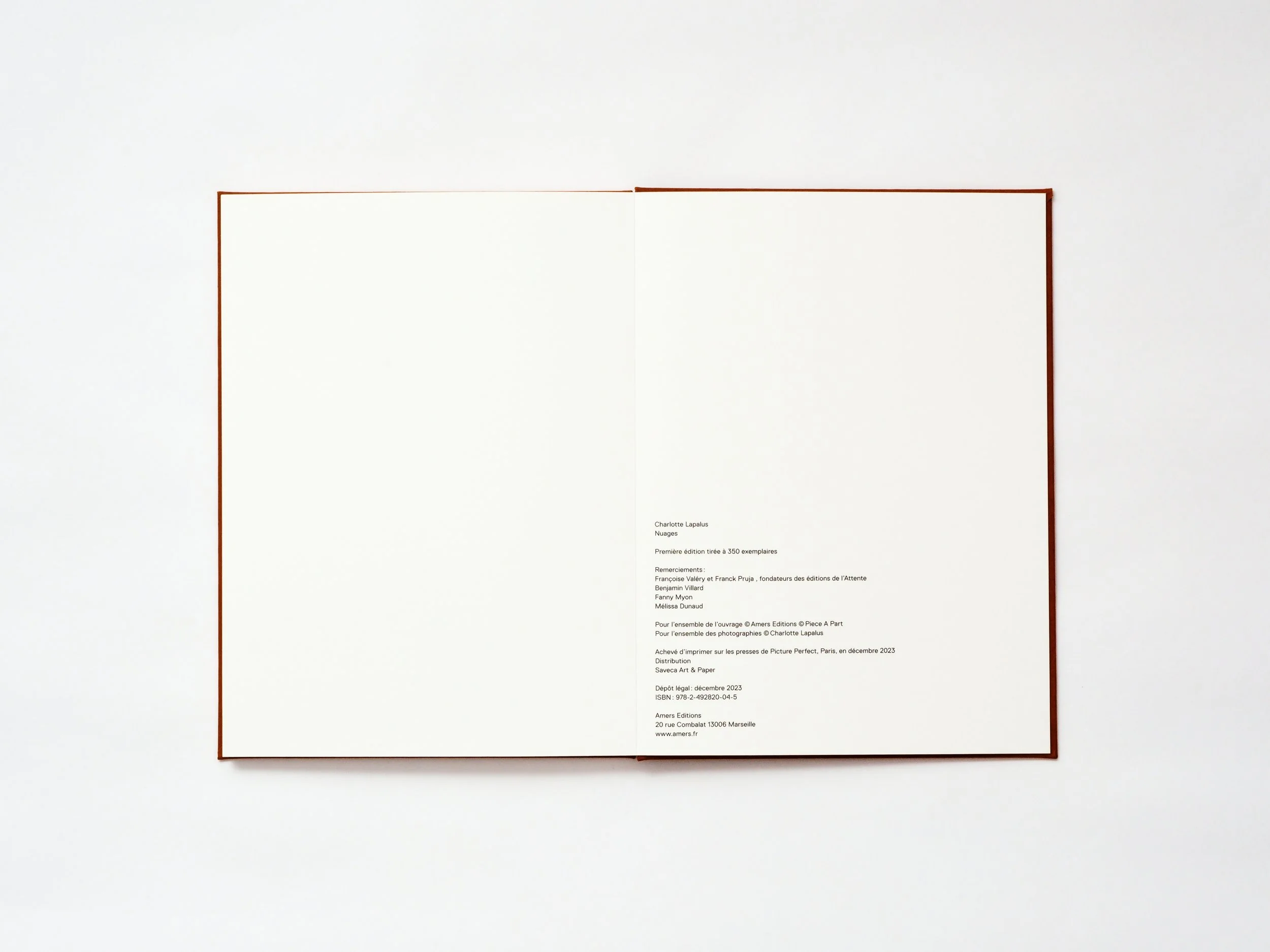
Hardcover cloth binding, Layflat exposed spine
21.2 × 29.2 cm
42 pages, 15 photographs
December 2023
Printed in Paris on the presses of Picture Perfect
Amers Editions, 2023
ISBN 978-2-492820-04-5
First edition, limited to 350 copies
© Amers Editions
Original: $72.17
-65%$72.17
$25.26


Description
Book Launch / Signing
January 23, 2024
6 - 8 PM
***
"1802, Lombard Street, London: a certain Luke Howard (1772–1864), an English pharmacist who became a renowned meteorologist, proposed a new classification of clouds. Naming three main categories—cumulus, stratus, and cirrus—as well as a series of intermediate states and modifications, such as cirrostratus or stratocumulus, Howard emphasized the intrinsic mutability of clouds, a crucial point—and fundamentally poetic task—that had been missing in the first classification attempt made earlier by the French naturalist Jean-Baptiste Lamarck (1744–1829).
From then on, history would recognize Howard as the “inventor of clouds,” science would adopt his system, and artists would draw inspiration from it. Seas of mist in Caspar David Friedrich, stormy skies in William Turner, or puffy masses in Eugène Boudin: for the British critic John Ruskin, the 19th century was “in the service of clouds”[1]. Among these painters attentive to atmospheric variations, John Constable (1776–1837), settled atop Hampstead Hill in north London, devoted himself particularly to the meticulous study of clouds. For Constable, the shapes and colors of these water vapor masses—and through them, the scientific phenomena that gave rise to them, as well as the weather that would follow—became genuine objects of study.
At the end of the 19th century, in 1873, three meteorologists from the International Meteorological Organization—Hugo Hildebrand Hildebrandsson, Albert Riggenbach, and Léon Teisserenc de Bort—were tasked with creating the first International Cloud Atlas. They worked on it for twenty-three years, and the first edition was finally published in 1896. In addition to paintings and drawings, it featured, for the first time, color photographs of clouds, a complicated and costly process at the time. The work, still relevant scientifically today, can also be regarded as an art book, reflecting the alliance between science and photography, as well as the infinite aesthetic potential of clouds.
It is in this light of pictorial and meteorological studies that we can understand Charlotte Lapalus’ book “Nuages”, which, from Europe, Canada, or the Sahara, continuously records remarkable states of the sky.
Her framing, devoid of any terrestrial reference, recalls Constable’s Cloud Studies: the sea above which clouds form, the mountains in which they cling, or the plains darkened by their passage all disappear from her photographs. Attention is entirely focused on the motif and the light: here, the opaline filaments of a cirrus, there the dark, muted curls of a cumulonimbus, or the restless masses of nimbostratus slowly coalescing before suddenly glowing from within. In a chromatic stroll—reflecting their evolving nature—clouds shift from white to gray, turning pink, yellow, or purple, depending on altitude, the blue of the sky, or the sun’s position relative to the horizon. At times, special illuminations, such as fires or city lights, interfere with their natural colors.
New questions arise in the Anthropocene. Contrails from jet planes, urban smogs, factory plumes, and mushroom clouds have entered the atmospheric landscape since the beginning of the Industrial Revolution. These are called anthropogenic clouds, all sharing the common feature of being artificially created by human activity.
Moreover, in the 1950s, the first tests of cloud seeding—and with them climate manipulation—began raising new health, ecological, and geopolitical concerns, including the potential establishment of a legal status for clouds, which seemed to know no borders, yet became entangled in weather-related conflicts. While the effects of their behavior and future transformations play a decisive role in climate disruption, they remain one of the main sources of uncertainty faced by researchers and modelers.
In this nebulous context, Charlotte Lapalus’ photographs appear as a call to cultivate our powers of observation, to enhance our attention and interest in these cottony giants. Their masses, sometimes imposing, their muted or incandescent tones, shout mystery, urgency, and poetry, a triad with which one must contend when speaking of these scientific UFOs that endlessly form at the surface of the water and rise into the troposphere."
[1] John Ruskin, Modern Painters (1840)
Hardcover cloth binding, Layflat exposed spine
21.2 × 29.2 cm
42 pages, 15 photographs
December 2023
Printed in Paris on the presses of Picture Perfect
Amers Editions, 2023
ISBN 978-2-492820-04-5
First edition, limited to 350 copies
© Amers Editions